
By Allan R. Hoffman
I returned recently from a two-week visit to Scotland, my wife’s home
country. She and I are now the owners of a flat (apartment in
Americanese) in East Kilbride, near Glasgow, that makes visiting with
her family much easier. Another exciting feature is that on all clear
days (it happens occasionally in Scotland) we can see, from the flat’s
bedroom windows, wind turbines spinning in the nearby Whitelee wind
farm, currently the largest operating onshore wind farm in Europe (just
under 600MWp). The wind farm is several miles away from the flat.

The purpose of this blog post is to discuss the exciting developments
taking place in Scotland’s energy system, where the stated national
goal is to go 100% renewables for electricity supply by 2020. Achieving
this goal, whether in 2020 or sometime in the decade afterwards, will
rely heavily on Scotland’s large wind resources, both onshore and
offshore. As a sparsely populated country (total population is 5.4
million) with significant renewable energy resources, Scotland “..is in a
unique position to demonstrate how the transition to a low-carbon,
widely distributed energy economy may be undertaken.”
What is Scotland’s current energy situation? In Late November 2014
it was announced by the independent trade body Scottish Renewables that
“.. with numbers from the first half of 2014, ..renewable energy was
Scotland’s largest source of (electrical) power.” Specifically, for the
first half of 2014, renewables provided 10.3 TWh of electrical energy,
while nuclear power, previously Scotland’s main sources of electricity,
provided 7.8 TWh. Coal was third with 5.6 TWh with natural gas at 1.4
TWh.
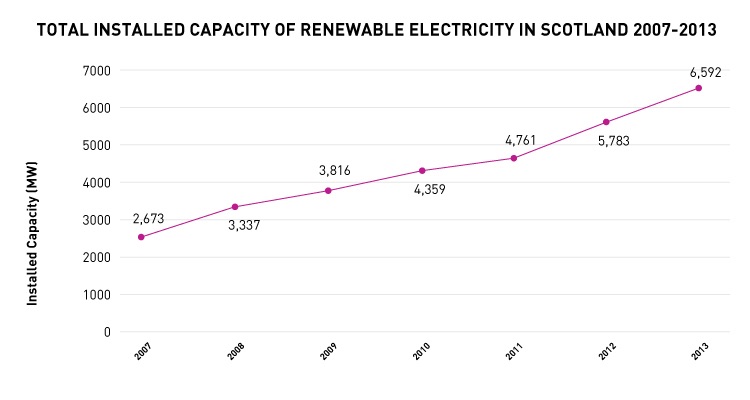
This increase in renewable generation continues the trend shown in the following chart:
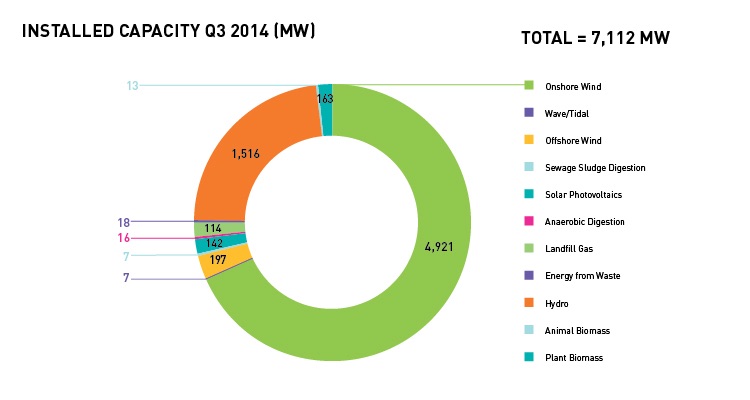
Installed renewable capacity increased to 7,112 MW by the end of the
3d quarter of 2014 – mostly onshore wind and hydro – with another 441 MW
of wind capacity (onshore) in construction, 7,720 MW (onshore and
offshore) awaiting construction, and 3,765 MW (onshore) in planning.
Small amounts of other renewable generation (biomass, landfill gas,
hydro) are also in the pipeline.
With wind power already generating enough electricity to supply more
than total Scottish household demand, Niall Stuart, Chief Executive of
Scottish Renewables, sees much more potential in the future: “Offshore
wind and marine energy (wave, tidal, ocean current) are still in the
early stages of development but could make a big contribution to our
future energy needs if they get the right support from government. That
support includes the delivery of grid connections to the islands, home
to the UK’s very best wind, wave and tidal sites.”
Scottish enthusiasm for renewables was bolstered by a report issued
by WWF Scotland in January (‘Pathways to Power: Scotland’s route to
clean, renewable, secure electricity by 2030′) which concluded that,
with respect to electricity, a fossil fuel-free Scotland is not only
technically feasible but “..could prove a less costly and safer option
than pursuing fossil fuel- based development..” that assumes carbon
capture and sequestration (CCS) technology will be operating at scale in
2030. With regard to the Scottish government’s stated goal of
decarbonizing the electrical sector by 2030, Paul Gardner of DNV GL,
lead author of the report, has stated that “There is no technical reason
requiring conventional fossil and nuclear generation in Scotland.” In
addition, Gina Hanrahan, climate and energy officer at WWF Scotland,
explained that “The report shows that not only is a renewable, fossil
fuel-free electricity system perfectly feasible in Scotland by 2030,
it’s actually the safe bet. Pursuing this pathway would allow Scotland
to maintain and build on its position as the UK and Europe’s renewable
powerhouse, cut climate emissions (electricity generation accounts for
one-third of Scotland’s emissions) and continue to reap the jobs and
investment opportunities offered by Scotland’s abundant renewable
resources.”
What is Scotland’s natural resource base for renewables? In addition
to its existing installed capacity of hydropower (1.3 GW), it is
estimated that wind, wave and tide make up more than 80% of Scotland’s
renewable energy potential – 36.5GW/wind (onshore and offshore), 7.5
GW/tidal power, 14 GW/wave power. This total, almost 60 GW, is
considerable greater than Scotland’s existing electrical generating
capacity from all fuel sources of 10.3 GW.
It is interesting to note that Scotland also has significant fossil
fuel resources, including 62.4% of the European Union’s proven oil
reserves, 12.5% of the EU’s proven natural gas reserves, and 69% of UK
coal reserves. Nonetheless, the Scottish Government, as discussed
above, has set ambitious goals for renewable energy production. This is
likely driven by concern for global climate change and the economic
potential for Scotland as a major source of renewable energy.
http://cleantechnica.com/2015/05/11/scotlands-energy-system-exciting-changes-happening/
No comments:
Post a Comment