
Back in 2012, ILSR released a pair of reports on the solar Rooftop Revolution,
noting that one-third of Americans would live in a metropolitan area
where the cost of solar energy from their roof would be less than the
cost of power from the utility by 2021. When combined with our analysis
of non-residential property, we estimated that 287 gigawatts of solar
would be at price parity with grid electricity across the country by
2021.
It turns out we were wrong, and that the rapidly falling cost of
solar is making solar more economical in more big cities than many
people expected. For example, in our original analysis looking for parity between
solar and grid electricity prices on residential property in 2015,
residents were expected to save money by going solar in only 2 of the
largest 42 U.S. metro areas, New York and San Diego.* According to a recently released report
by the North Carolina Clean Energy Technology Center, however, grid
parity was coming much quicker. A review shows that their study included
all applicable federal, state, and local incentives (instead of our
no-subsidy analysis), but it gave us a reason to revisit our 2012 analysis.
As it turns out, solar parity––without incentives––has been accelerating.
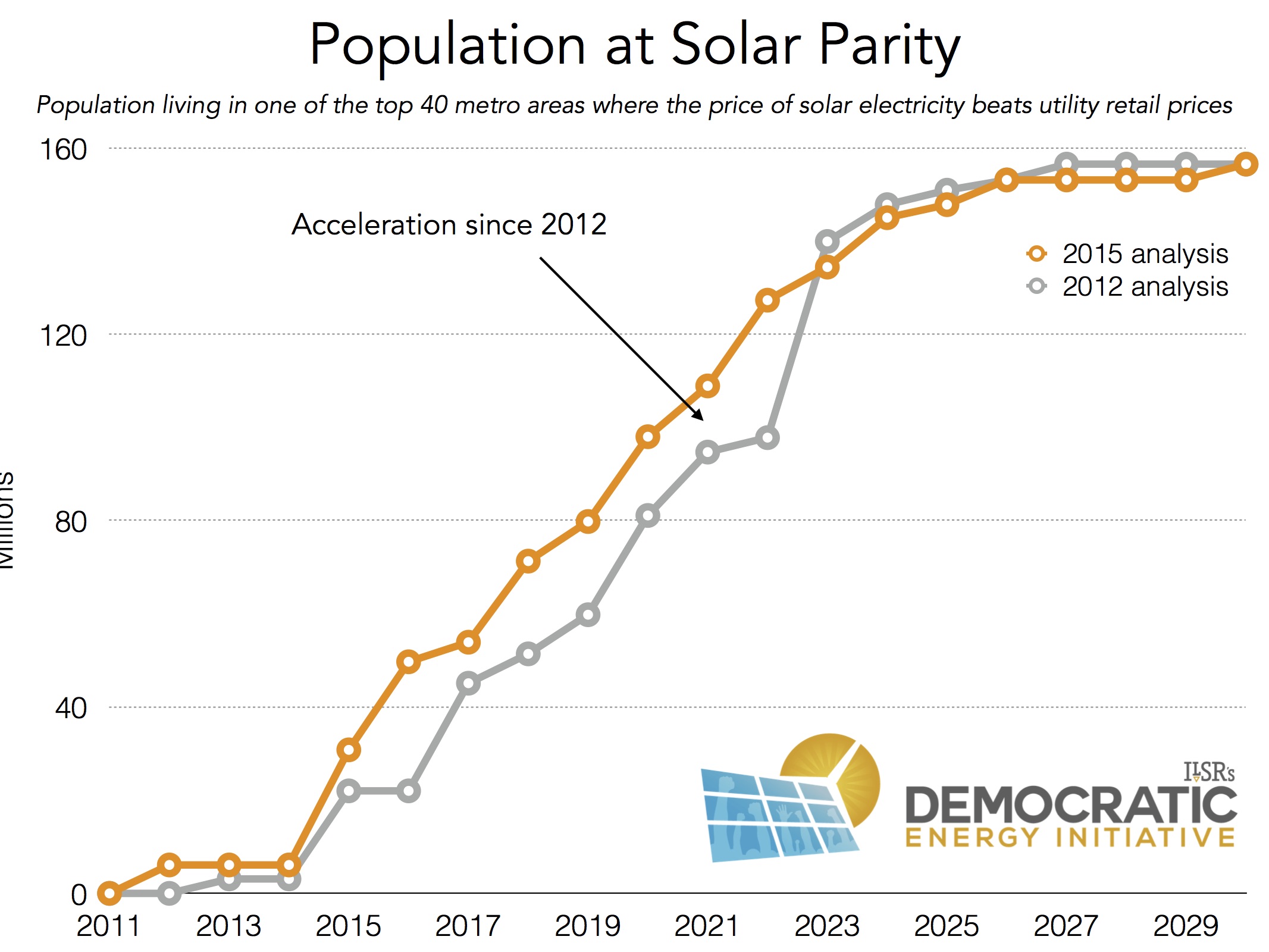
In 2015, six of the largest metropolitan areas are already at solar
parity, representing over 30 million Americans. That’s one-third more
people living with solar at parity with utility electricity prices than
in our original analysis, when we calculated that 2015 would bring
parity to just two metro areas, totaling 22 million people. The
following table lists the metropolitan areas where electricity from
solar installed at $3.50 per Watt––with no incentives––matches the
average electricity rate, and a comparison to our original 2012
analysis.
Cities at Solar Parity in 2015
| Metro Area | Original Analysis | Revisited Analysis |
| New York | 2015 | 2016 |
| Boston | 2020 | now |
| San Francisco | 2017 | now |
| San Diego | 2013 | now |
| San Jose | 2017 | now |
| Los Angeles | 2017 | now |
| Riverside, CA | 2017 | now |
In 2017, the five-year point in our original, the population at
parity is likely to be 71 million instead of 51 million. By 2021, 109
million Americans will be at parity, instead of our original prediction
of 95 million.
Cities at Solar Parity in 2021
| Metro Area | Original Analysis | Revisited Analysis |
| New York | 2015 | 2016 |
| Boston | 2020 | now |
| San Francisco | 2017 | now |
| San Diego | 2013 | now |
| San Jose | 2017 | now |
| Los Angeles | 2017 | now |
| Riverside, CA | 2017 | now |
| Chicago | 2023 | 2018 |
| Dallas | 2019 | 2019 |
| Philadelphia | 2020 | 2018 |
| Houston | 2021 | 2020 |
| Miami | 2021 | 2020 |
| Detroit | 2023 | 2020 |
| Phoenix | 2018 | 2017 |
| Tampa | 2020 | 2021 |
| Baltimore | 2023 | 2021 |
| Denver | 2020 | 2021 |
| Pittsburgh | 2024 | 2020 |
| Sacramento, CA | 2018 | 2019 |
| Las Vegas | 2019 | 2018 |
| Providence, RI | 2020 | 2021 |
| Jacksonville, FL | 2022 | 2021 |
As you may notice in the above chart, some cities have reach parity
sooner, and some later. The following map illustrates the changes by
city for all 40 metropolitan areas. What’s not captured in the table
above or the map is that the acceleration of grid parity seems to be
concentrated in the largest metropolitan areas, pushing up the
population at parity despite nearly as many cities losing ground toward
parity as gained between our new and original analysis.

In the future, we’ll add a bit more, by examining the net present
value of a solar investment in each city. This accounts for the fact
that an investment in solar can make sense even if the cost of solar
electricity is currently higher than retail prices because, in the long
run, solar prices are fixed, but electricity prices tend to rise. Early
results suggest that nearly 150 million Americans––33% more than a
simple parity analysis reveals––will live in a city where a solar
investment––without subsidies––pays back over 25 years by 2021. More to
come…
Data and Assumptions
*We picked these 42 because half the U.S. population lived in those 42 metropolitan areas in 2012.
- The installed cost of solar for this analysis is $3.50 per Watt in 2015, estimated to decrease 7% per year
- The price of electricity is expected to increase by 2% per year
- Electricity prices for each metro area were taken from the Bureau of Labor Statistics or Energy Information Administration
- Solar insolation data comes from the National Renewable Energy Laboratory’s PVWatts system
http://cleantechnica.com/2015/05/22/solar-parity-coming-faster-expected/