
Alternative energy became a serious market player after the turn of
the millennium. Since that time, solar, wind, smart grid and other
alternative energy stocks have experienced both strong up and down
trends. The forces at work driving these markets are complex,
counterintuitive, and sometimes mysterious. This article looks at what
has been driving the price of alternative energy markets, and as a
result, alternative energy company stocks. Looking ahead, we will also
consider what should affect the direction of alternative energy stock
prices.
Past Trends in Alternative Energy Stocks

The Wilder Hill New Global Index (NEX) is a fitting proxy to track
overall alternative energy markets. This index contains companies
that “focus on generation and use of cleaner energy, conservation and
efficiency, and advancing renewable energy generally.” The chart at
right shows some of the clear trends the alternative energy sector has
had in the recent past. The first down channel on the chart coincides with a general stock
market slump. This drop started during the eight month recession which
began in March 2001.
By 2003, alternative energy stocks started to turn around. This
marked the beginning of a fantastic five year run, as investors started
noticing wind power and photovoltaics were becoming economically viable
alternatives to traditional electric generation. Annualized returns in
this five year period averaged a remarkable 38 percent!
The Great Recession then hit in December 2007, just as alternative
energy stocks appeared to be ascending into nosebleed territory. As a
result, prices came crashing down a painful 71 percent in about a year.
This outstripped the distressing declines the stock market in general
had at that time.
After this crash, no clear trend emerged until the end of 2012, when
the next up-channel started. At that time, investors felt that
alternative energy stock prices better reflected the economic realities
of the underlying business, and started buying again. There is likely
another reason, though, that it took five years for alternative energy
markets to recover. Psychologically, after getting severely burned in
the crash of 2008, it took a long time for investors to feel comfortable
dipping their toes back in the water.
Following the uptrend that went from 2012 to the beginning of 2014,
there was a noteworthy giveback. The NEX fell 21 percent in about nine
and a half months. Much of that giveback has been regained. It remains
to be seen if the current trend will continue to be positive, or if we
have entered into a sideways market.
Do Fossil Fuel Prices Drive Alternative Energy Markets?
Are fossil fuel prices the main driver of failure or success of green
energy companies? Though this seems like a reasonable theory, the
answer, in my analysis, is that it depends.
Alternative Energy versus Oil

Most of the larger alternative energy stocks are multinational
corporations that are part of an international economy. As a comparison,
crude oil prices are good indicator of global fossil fuel values. Oil
is a worldwide commodity that can more easily flow to markets than coal
or natural gas. The latter two fossil fuels are subject to local
supplies and disruptions, so prices can range widely by region.
The chart at right shows crude oil (Cushing OK spot)
as compared to the NEX over two time periods. From 2001 to 2009, oil
and alternative energy prices were very strongly linked. For you math
wonks, the two had a correlation coefficient of 0.87, which is extremely
significant. This makes sense, since a rise in oil prices would mean
that other energy alternatives become more attractive. From 2010 to the
present, the NEX had a slight negative correlation to oil prices. The
two markets did not exactly go in opposite directions, but they had
virtually no corresponding movement.
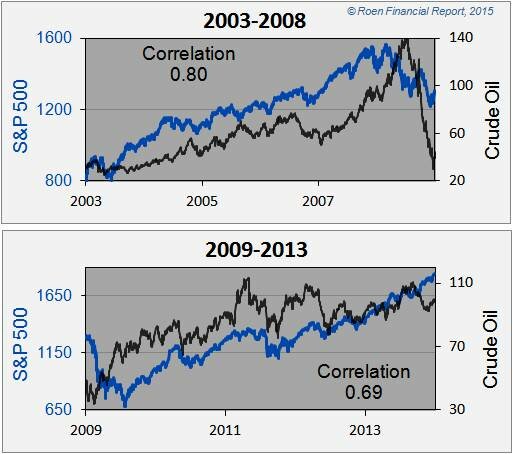
A further reason for the 2002-2009 correlation is that the economy
was humming along very well at that time. This helped fuel investor
optimism that the market would continue to grow for solar, wind, and the
like. Similarly, oil became a strong proxy for the stock market at that
time, as speculators started investing heavily in oil. They believed
that as the global economy expanded, there would be more demand for oil,
thus raising the prospects for oil prices. In essence, oil became a
proxy for the stock market. The correlation between oil and the stock market remained strong for a
decade, but finally started to diverge at the end of 2013. Since then
there has been a strong negative correlation.

Oil prices are now being affected more by supply and demand. Much of
this has to do with the North American oil and natural gas boom, which
is injecting an abundance of supply right where it is being used. This
not only tips the supply/demand equation by reducing U.S. oil imports,
but also mitigates the fear that oil prices will skyrocket when a
crisis crops up in the Middle East. For this reason, I expect any rise
in oil prices going forward will positively affect alternative energy
stocks.
Alternative Energy versus Natural Gas

Often, the decline in alternative energy electricity generators such as wind and solar has been attributed a drop in natural gas prices. There is a correlation between the two, though it is not as strong as one might think. The charts at right show natural gas (Henry Hub LA spot)
compared to the NEX. There is a clearly a correlation between the two,
though it is somewhat weak. It is also interesting to note that at
starting around 2015, there was a divergence between natural gas prices
and the NEX.
Prospects for Alternative Energy Stocks
Though no one can tell with certainty where alternative energy stocks
will head in the future, there are factors that can shed some light on
the long-term prospects for this sector. These include increased
manufacturing efficiencies, financial innovations and energy policy.
Efficiencies
Much of what many alternative energy companies do is similar to tech
sector stocks. As product design and production engineering keeps
improving, manufacturing efficiency can greatly help a company’s bottom
line. Whether its photovoltaics, LED lighting or wind arrays,
the cost of production continues to drop for green economy companies.
This trend shows no signs of abating, which bodes well for alternative
energy investors.
Financial Innovations
The alternative energy sector has profited greatly from new and innovative financial models. Companies like SolarCity (SCTY) and SunPower (SPWR) have
benefited from various financial arrangements that allow consumers to
install solar with no upfront costs. These include lease arrangements,
power buyback agreements, and securitization of tax benefits.
Another innovative financial model to benefit alternative energy is the advent of renewable YieldCo’s.
These are companies that bundle solar and wind generating assets into
predictable cash flows that are paid out in dividends. This innovation
allows green investors can choose from several companies with strong yield attributes.
Investors love dividends, especially in this low interest rate
environment. Any added yield an investor can put in their portfolios is
of great value. YieldCo’s should continue to attract investors and lead
to higher stock prices. These types of financial innovation reflect a maturing of the
alternative energy sector, which I see as a good sign. As long as these
products have strong fiscal underpinnings, the prospects for long-term growth remain healthy.
Energy Policy
Because of the public good that results from reduced fossil fuel use,
alternative energy has benefitted from government policies supporting
the industry. Indeed, targets and incentives remain strong
internationally, particularly in Europe and Asia.
These regions and others continue to be serious in their commitment to
solar, wind, energy storage, efficiency and other alternative energy
strategies. Domestically, there are two important policy developments to
watch, one a carrot and one a stick.
The first important domestic incentive is the Business Energy Investment Tax Credit (ITC).
The ITC rebates up to 30 percent for solar, fuel cells, wind, combined
heat and power (CHP) and geothermal. This incentive is scheduled to
sunset at the end of 2016. Whether it gets renewed or not will affect
the rate at which renewable projects go forward. This will cause concern
for investors.
The second policy development is the Clean Power Plan.
These proposed rules from the EPA target pollution reduction from power
plants, and will have a vast affect on how energy gets produced and
consumed in the country. Essentially each state has an emission target,
which will force it to find ways to reduce carbon emissions. There has
been some strong pushback from many states, especially those heavily
reliant on coal for production electricity. The rule making process will
likely take a few years and several court cases to resolve, but if the Clean Power Plan remains mostly intact, it will accelerate renewable energy projects in a big way.
Conclusion
By keeping an eye to the ground on fossil fuel prices, energy
policies and other factors, investors can go far to understanding
prospects for alternative energy stocks. There will undoubtedly be up
and down swings ahead, but there are enough positives underlying the
sector that we remain bullish for the long-term.
http://www.renewableenergyworld.com/articles/2015/05/what-drives-alternative-energy-stocks.html