
By Matt Golden, Senior Energy Finance Consultant


A few days ago, economists from the University of Chicago and the University of California, Berkeley released a study
that called into question the cost-effectiveness of energy efficiency.
The study was based on the team’s analysis of energy savings shortfalls
in the Michigan low income Weatherization Assistance Program. Since
then, a host of articles have used the study’s results to call into
question the value of utility-sponsored energy efficiency programs.
While
this study did raise some thought-provoking points, it also contained
biased assumptions and reached conclusions that far exceed its scope,
lumping together market-based efficiency with low-income weatherization
programs.
The report paints what can only be
considered a worst case scenario. For example, it counts the costs of
delivering health and safety upgrades without measuring the benefits, it
assumes energy prices will never rise, and it extrapolates lessons from
a publicly-funded social benefits program (designed to serve
hard-to-reach citizens) to all sectors of the energy efficiency market.
The Natural Resources Defense Council (NRDC) and the Illinois Institute of Technology
have published good posts that explore in great detail some of the
flaws in the assumptions and conclusions reached in the report.
However,
this study also points to some very real and critical challenges,
namely that: 1) existing models for estimating efficiency over-predict
savings; 2) public programs are an expensive way to deliver services;
and 3) public investments in efficiency can be valued in a number of
ways producing widely varying results. The authors also correctly assert
that we need to be serious about how we invest in carbon abatement, as
the problem is so large we can’t afford to waste resources. Let's
unpack their conclusions.
Do energy models over-predict?
It’s
fairly well known and understood that current modeling approaches
over-predict baseline energy usage, and therefore the savings that
result from efficiency upgrades. This is not the first study to show
there is a bias toward over-prediction, especially in un-calibrated
energy models. This article examines many of the core reasons why this bias exists and there are many efforts underway to correct the problem.
A better approach is to use actual energy data, not just engineering models. One recent study
in New York State by Performance System Development shows that
calibrating predictions to past bills dramatically improves results.
California is taking a different approach with the CalTRACK
system, which uses electricity meter data to track actual savings and
adjust predictions to match actual performance – all while creating
transparency in the marketplace.
Does efficiency have a good payback?
Measuring
the cost effectiveness of an energy retrofit simply by dividing the
total cost of an improvement by the savings is an oversimplified
approach. Considering the host of non-energy benefits in residential
retrofitting such as comfort, residential energy efficiency is put at an
unfair disadvantage when we compare the full cost of a project against
just the energy savings (more on this here). These issues are particularly pronounced for publicly-funded weatherization programs for low-income residents.
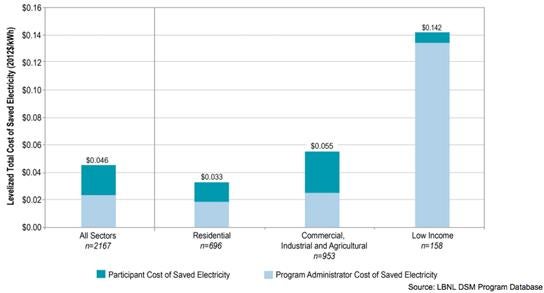
Total cost of saved electricity broken down by participants (building owners) and program costs. (Source)
Furthermore,
comparing public costs associated with low-income weatherization to
market-based energy efficiency is inappropriate. Low-income
weatherization is much more expensive than market-rate efficiency
programs due to a host of factors, some of which were covered in the
report. But in summary, compared to low-income programs, the cost of
energy efficiency is much lower in market-rate sectors and public
dollars are a much smaller percentage of the total investment.
Is efficiency a cost-effective way to mitigate carbon?
Numerous
studies have calculated that the public investment in energy efficiency
is more cost-effective than procuring new power sources. Even if real
costs are higher than previously thought, efficiency provides a critical
and immediate opportunity for large-scale emissions reductions that are
cost-effective compared to other options.
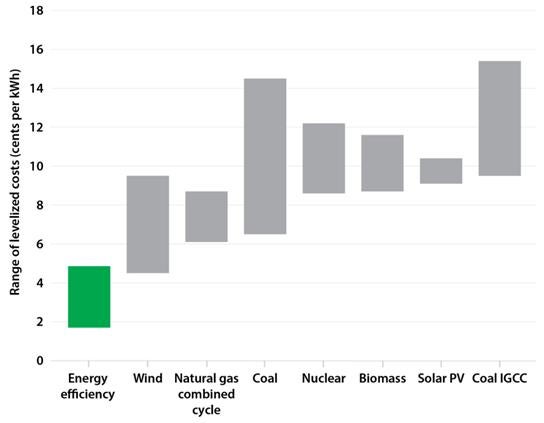
Levelized costs of electricity resources per kWh (in other words, how much each type of energy costs). (Source)
The
important question here is not whether public investment in efficiency
is a good value, but rather, how do we maximize our efficiency returns?
The energy efficiency industry is ripe with innovative business models,
new types of financing, and advanced building technologies driven by a
combination of access to data, engaged capital markets, and the existing
and impending regulation of carbon emissions in power production.
Valuing efficiency savings based on actual results will also complement a
carbon price. The takeaway should not be to give up on efficiency
but to aggressively encourage innovation and experimentation that can
overcome the barriers to this critical carbon-free resource.
Let’s toss the bathwater and leave the baby
Rather
than pay for efficiency through engineering models and upfront rebates,
we are now able to track actual energy savings at the electricity meter
and pay for actual performance as it is delivered — like every other
commodity and energy source. The conclusion that energy efficiency
should not be a meaningful part of our country's climate and energy
solution is premature at best.
We must move away from basing
efficiency investments on engineering models that incorrectly forecast
energy savings, and toward investments in calculated efficiency gains
based on the meter. Rather than rely on top-down programs that pay
rebate coupons upfront, we should establish markets that price savings
based on levelized avoided cost of new generation
and pay for results as they occur, just like purchasing capacity
(generated electricity from coal, natural gas, or renewable sources like
solar).
By leveraging smart meter data, available tools such as the Open EE Meter, which calculates and tracks energy savings based on open standards and code, and systems such as the EDF Investor Confidence Project,
which standardizes and certifies energy efficiency projects ready for
investment, we can establish markets for energy savings that treat
efficiency like a capacity resource. When systems are in place to
standardize how reductions in energy use are measured, they can earn a
real market value and help avoid building new power plants. These
systems will also give investors confidence that energy efficiency
projects are reliable, savings are predictable, and risk is manageable.
Power
generators finance their investments based on future cash flows from
selling energy, also known as project finance. If energy efficiency is
going to play its part in the new utility paradigm, it’s time we start
financing it like an energy infrastructure investment. Project finance
for a power plant is based on the long term cash flows from selling
power. When we meter energy efficiency and pay for savings as they are
delivered, we turn energy efficiency into a cash flow, which can then be
financed.
As this new market-based approach
takes hold, utilities and program administrators will finally be able
to get out of the business of figuring out how to deliver energy
efficiency services through programs, and instead focus on procuring
demand-side resources in much the same way they already procure
capacity. In a recent California Public Utilities Commission filing,
PG&E (one of California’s largest utilities) supported a pilot recommended by NRDC
to test just such an approach, saying that it “has the potential to
facilitate comprehensive upgrades while simultaneously minimizing
implementation costs through leveraging private capital."
With the
private market taking on the risk of upfront investment in energy
efficiency programs, regulators will be able to focus on protecting
people and businesses through a well-regulated market structure that
sends the right price signals, and leaves the business model of energy
efficiency up to the private sector.
Building owners will benefit
from a competitive industry incentivized to develop innovative business
models and products, and the private sector will be able to invest in
this critical market with the clarity of a price signal aligned with
public policy goals, their bottom line, and customer demand. Before
we judge efficiency, we need to measure and value it. Doing so will
allow us to treat efficiency like every other energy resource and enable
market forces and competition to determine the winning solutions.
http://www.theenergycollective.com/edfenergyex/2243316/don-t-write-energy-efficiency-it-s-just-about-have-its-day