
It was with great fanfare that Tesla launched its home battery recently. Headlines like “Tesla launches Powerwall home battery with aim to revolutionize energy consumption”
were the norm as the public read about this revolutionary jump forward
in energy storage. A recent article on where famed author Margaret Atwood is investing says it all
“if
[Tesla CEO] Elon Musk was putting his Powerwall on the market, I would
certainly buy a piece of that. My feeling is that, once that becomes
affordable, everyone is going to do that. I think that’s definitely the
wave of the future.” After all, this is the dream isn’t it?
We can all generate our own electricity with clean energy efficient
solar panels and store enough on our home batteries to keep us going
when the sun goes down. What can be better for our common future?
Well, in fact, just about everything.
It
must be my age and my years in the energy industry that remind me of
what are the real essential attributes of electricity supply. Reliability and Economics.
Yes, that’s right. For anyone who works in a modern electricity
utility, that is what they focus on; delivering cost effective reliable
electricity to users. And in today’s energy intensive world where we
need electricity for every aspect of our hyper active and energy
intensive lives, this is even more critical. We have all experienced
temporary blackouts and know well the negative impact it has. The
problem then with renewable energy generated at home is that, at least
for now, it is neither reliable nor economic. Since the announcement
from Tesla there have been a number of articles that explain this in detail, but of course supporters will just say that in time all problems will be solved. And frankly they may be right.
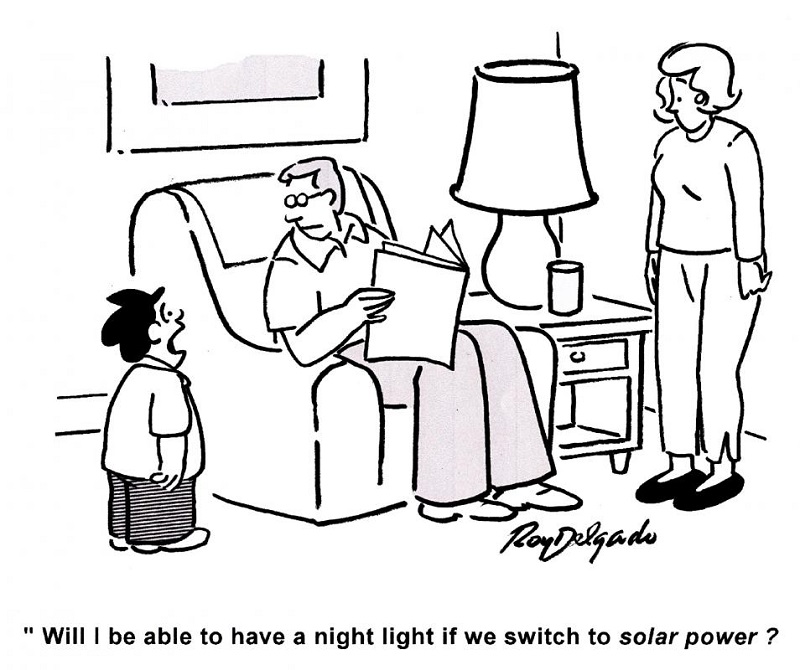
So
let’s step back and ask ourselves a more important question – are we
trying to solve the right problem? Most people have no idea what it
takes to generate and deliver the electricity (the so-called “grid”) we
take for granted in the modern world. In fact, many just think
electricity is something that comes out of the wall outlet. What we all
want is that when we turn on the switch, or plug in our phones, it just
works. We are not in any way prepared for a world in which we say – oh,
it’s cloudy so we better not charge our iPhone today! I love the recent TV ads where BMW
is explaining how they build their new I3 electric car in wind powered
factories. Yet, do any of us really think that on days when it is not
windy, these factories sit idle? No, of course not.
In most
advanced economies around the globe we have achieved a high level of
reliability in electricity supply. In fact this is one of the measures
that makes an economy ‘advanced’. The problem is that much of our electricity is generated with fossil fuels; primarily coal.
(Coal continues to be the largest source of Germany’s electricity where
BMW has its factories, at nearly 50% of total supply). And along with
this comes both pollution and a high level of carbon emissions.
Therefore, the only way to address these environmental issues is to
reduce the use of fossil fuels, not to eliminate an integrated grid.
Just
like being connected to the internet improves our lives, so does being
connected to a reliable electricity grid. Do we really want to live a
life where if it is cloudy for a few days and our batteries run dry we
do without? Of course not. Just imagine how much excess battery capacity
we would each need to avoid this possibility. Even Elon Musk notes that
his battery is currently for emergency backup
– not for daily use – and yes it would be great to have some amount of
reasonably economic backup for when we experience an outage. But as is
starting to be seen in California where there are numerous discussions
of the “duck curve”,
people want it all – they want to generate their own electricity when
they can believing this is the best approach, but they also want the
system to be there just in case they need it; and at a moment’s notice.
The result – higher costs all around. The less the grid system is used,
the more it costs to keep the infrastructure in place to make up the
shortfall when needed.
The answer is simple, let’s take what works
and make it even better. That is a large interconnected grid that
includes large scale reliable economic generation based on nuclear
power, and hydro where available, supplemented by wind and solar
depending upon the local availability of these resources. To be reliable
and cost effective, a system needs generation that can run all the
time, not just when the wind is blowing or the sun is shining. As
storage technology improves, it can then contribute to both help manage
the intermittency of renewable generation as well as flattening the
demand curve to enable an even larger share of nuclear generation.
Remember,
our economy, and in fact our very way of life, is completely dependent
upon the availability of reliable, clean and economic electricity. So
while we may dream of not needing the grid as we each generate our own
electricity, what we really need is a strong well interconnected grid
made up of reliable economic nuclear power as its work horse, with wind,
solar and other forms of generation contributing when they can; all
coupled with new forms of large scale storage to both even out demand
and supply. Now this is more likely to be the system of the future.
http://www.theenergycollective.com/mzconsulting/2245299/reliability-means-being-connected-we-need-strong-integrated-electricity-system-