
Kansas City, MO, has neither the abundant sunshine nor high cost of
electricity that have driven solar installations in other cities.
Despite this, the city has close to 1.5 MW of solar in 59 separate
installations on municipal properties. Thanks to utility rebates, two
department leaders, and a unique opportunity that allowed it to access
the 30% federal tax credit, the city was able to make solar work in an
otherwise challenging climate of modest sun and low electricity prices.
In April, ILSR’s John Farrell interviewed Charles Harris, project
manager with the Kansas City. Harris suggested that the project got its
start in 2006, when the city established a Climate Protection Plan to
reduce greenhouse gas emissions from municipal buildings while getting
15% of their energy from renewable sources.
Kansas City’s Solar Opportunity
Like many municipalities, Kansas City feels cash strapped, Harris
said. So when Kansas City Power & Light (KCP&L) offered a $2 per
Watt rebate for solar, it became very attractive for the city. After
negotiating with two city departments, KCP&L and Brightergy agreed
to buy the solar materials, install them on the buildings, and guarantee
a certain amount of solar production for the city. In return, the city
entered into two separate 20-year leases with the companies, each
requiring no money upfront, with the monthly lease amount based on a
guaranteed amount of energy produced.
Limitations on Solar
While the rebate from KCP&L amounted to $50,000 per system, it
was also a limiting factor for solar installations. The program capped
the size of rebate-eligible projects at 25 kilowatts (kW), so none of
the city’s 59 solar arrays exceeds that size. In a followup email to the
interview, Harris said there was a possibility of putting another 330
kW of solar on the buildings with solar, if there was no installation
size cap for the rebates.
Other limitations in finding solar-suitable buildings included small
roof space, low building energy usage, and the short offer period of
KCP&L’s rebate. The building energy usage problem reflects a policy
issue. Under Missouri net metering rules, the city cannot aggregate its
building energy consumption, allowing it to use a solar array on an
operations building to offset energy use at city hall, for example. This
policy, aggregate net metering, is available in 17 states. Missouri also lacks virtual net metering,
allowed in 11 states, permitting cities (and other entities) to offset
energy use on its buildings with solar installed anywhere else in the
utility’s service territory.
70 Megawatts of Solar?
In the development of the Public Rooftop Revolution report, the
regional government for the Kansas City metro area—Mid-America Regional
Council—modified its solar suitability map to identify rooftop solar
potential on city-owned buildings. Their map, shown below, indicated
that the city could install nearly 70 megawatts of solar on its
buildings.
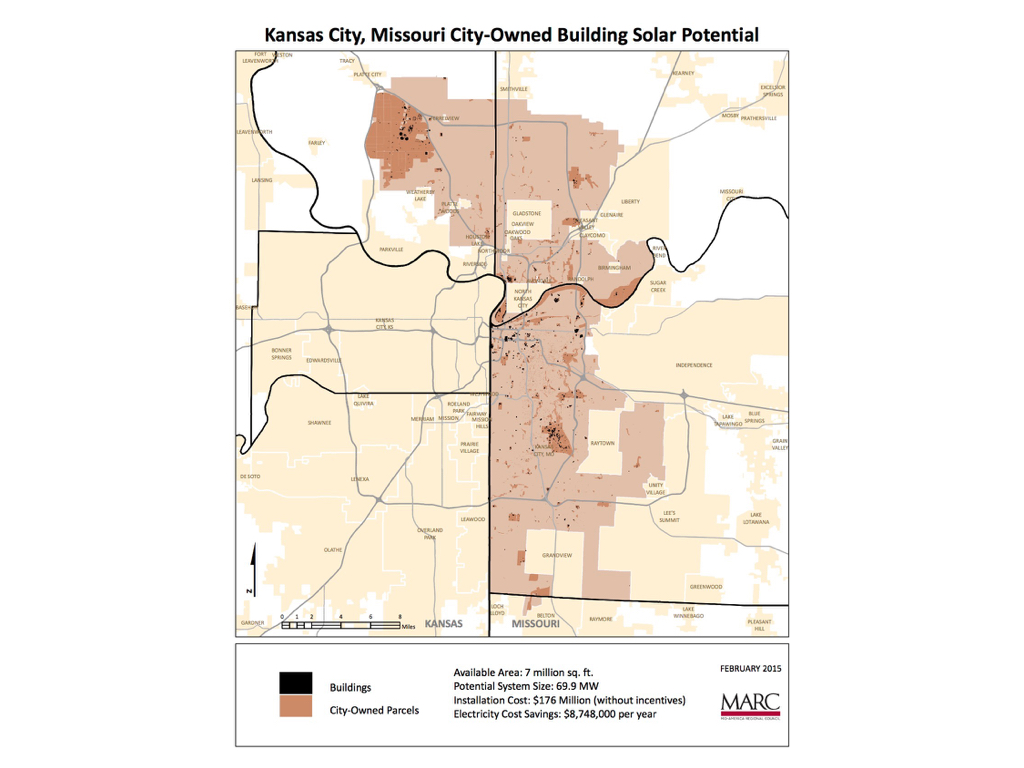
John asked Charles if that was a reasonable number for city
building-sited solar installations. Harris didn’t know where that number
came from, but his first thought was that the city didn’t own that many
buildings. In a followup email, Harris took a look at our map of 70 MW
of solar potential for KC’s city-owned buildings and concluded that well
over 90% of the buildings would not be right for solar. The reasons for
this run the gamut: vacant buildings, vacant parcels of land,
structural integrity, surrounding geometry, not enough utility use,
among others.
The Keys to More Solar
If there were more opportunities for rebates, Harris intimated that
his department, General Services, might interested in more solar for
their 140 buildings. A new LEED building requirement will likely
increase interest in solar for new or renovated municipal buildings.
There are other departments where solar facilities could be viable, too,
if the rebates were available again. The rebates were clearly the most important component in making solar
viable, according to Harris. Interestingly, even though the
installation cost of solar in many places is now less than $3.00 per
Watt for similar rooftop projects, Harris said in a followup email that
anything less than the $2.00 per Watt rebate would not meet the
financial goals of KCP&L and Brightergy. This remains confusing
since the utility and developer would both presumably be able to access
the federal tax credit and depreciation benefit, cumulatively worth
about $1.50 per Watt on a $3.00 per Watt installation.
The initiative for solar in Kansas City was mostly the city
departments. Although city council has its renewable energy advocates,
it was the two city departments that came up with the deal with KCPL and
Brightergy, and that pitched the deal to the other departments Harris said that one of the most important things is that everyone
has a chance to buy in. Every department in the city was given the
opportunity to get in on the deal with whatever buildings they
controlled, but only two followed suit. The end result has been a
winning deal for his department, Harris said.
“Because we’re saving in the amount of energy we’re getting from our local utility, it’s worthwhile.”
Kansas City’s experience with solar included a single, substantial
program across numerous government buildings, as well as a few smaller
projects. It’s unclear whether the city has much opportunity to expand
its solar investment, particularly given the constraints of the state’s
net metering policy and lease providers with apparently very high
financial requirements.
To learn more about solar efforts in Raleigh and other cities, read our Public Rooftop Revolution report, highlighting the remarkable opportunity for solar on municipal rooftops.
This is the 25th edition of Local Energy Rules,
an ILSR podcast with Director of Democratic Energy John Farrell
that shares powerful stories of successful local renewable energy and
exposes the policy and practical barriers to its expansion. Other than
his immediate family, the audience is primarily researchers, grassroots
organizers, and grasstops policy wonks who want vivid examples of how
local renewable energy can power local economies.
http://cleantechnica.com/2015/12/02/kansas-citys-royal-effort-solarize-city-rooftops-episode-25-local-energy-rules/
No comments:
Post a Comment