

Source: U.S. Energy Information Administration, U.S. Crude Oil and Natural Gas Proved Reserves
U.S.
crude oil and lease condensate proved reserves increased by 9% to 39.9
billion barrels, and natural gas proved reserves increased by 10% to 389
trillion cubic feet in 2014, according to EIA's U.S. Crude Oil and Natural Gas Proved Reserves
report. U.S. crude oil and lease condensate proved reserves reached the
highest level since 1972, and natural gas proved reserves surpassed
last year's record level.
Proved reserves
are volumes of oil and natural gas that geologic and engineering data
demonstrate with reasonable certainty to be recoverable under existing
economic and operating conditions. Because they depend on economic
factors, proved reserves shrink or grow as commodity prices and
extraction costs change. EIA's estimates of proved reserves are based on
an annual survey of domestic oil and natural gas well operators.
Texas
had the largest increase in proved reserves of crude oil and lease
condensate, representing 60% of the nation's total net increase in 2014.
This increase was driven by development of tight oil plays (e.g.,
Wolfcamp, Bone Spring) in the Permian Basin and the Eagle Ford Shale
play. North Dakota had the second-largest increase, 362 million barrels,
which came mostly from the Bakken tight oil play in the Williston
Basin.

Source: U.S. Energy Information Administration, U.S. Crude Oil and Natural Gas Proved Reserves. Note: Click to enlarge.
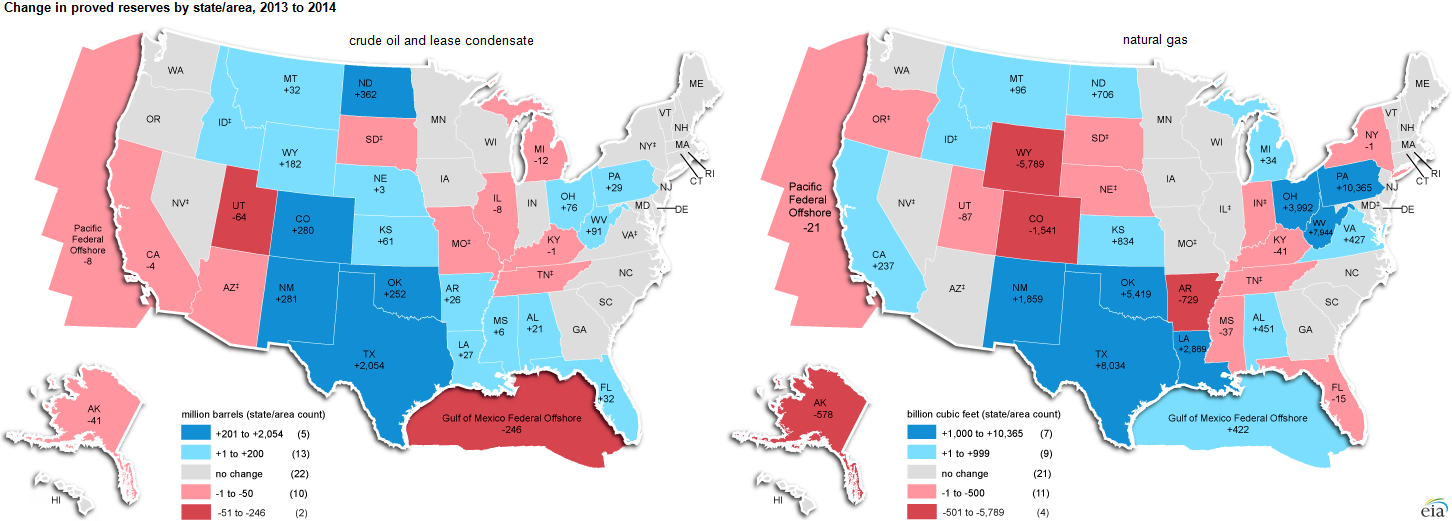
Proved
natural gas reserves were added onshore in the Lower 48 states in
several of the nation's shale formations, particularly the Marcellus
Shale play in Pennsylvania and West Virginia, the Eagle Ford Shale play
in Texas, the Woodford Shale play in Oklahoma, and the Utica Shale play
in Ohio. Natural gas in shale plays now represents slightly more than
half the U.S. total natural gas proved reserves.
Sustained lower
prices for crude oil and natural gas in 2015 are anticipated to reduce
oil and natural gas proved reserves in EIA's next annual report (for
year-end 2015). Lower prices have curtailed oil and natural gas drilling
and have made recovery economics more challenging. Although resource
estimates are not necessarily reduced by lower prices, the calculation
of proved reserves is sensitive to price.

Source: U.S. Energy Information Administration, U.S. Crude Oil and Natural Gas Proved Reserves
Principal contributor: Steven Grape
http://www.theenergycollective.com/todayinenergy/2294881/us-oil-and-natural-gas-reserves-both-increase-2014
No comments:
Post a Comment