

The
rapidly-growing Dallas-Fort Worth (DFW) metropolitan area in North
Texas has struggled for years to reach attainment with federal clean air
requirements for ozone, a problem that many environmental activists
have blamed on hydraulic fracturing (“fracking”). But a closer review of
publicly available data suggests there is no credible link between
ozone nonattainment and development of the Barnett Shale, over which
much of the Metroplex sits.
Ground-level ozone, also known as
smog, is formed when volatile organic compounds (VOCs) and nitrogen
oxides (NOx) interact with sunlight. An array of industrial activities
emit NOx and VOCs, although many regulators have identified tailpipe
emissions from cars and trucks as the main cause of smog.
Critics
of fracking have alleged for years that oil and natural gas activities
emit more ozone precursors than all of the cars and trucks on the road
in DFW. Downwinders at Risk, a local environmental group, told Fort Worth Weekly in 2011
that “the gas industry now emits more smog-forming volatile organic
compounds, or VOCs, than all the cars and trucks in D/FW combined.” As
part of its “Don’t Frack with NY” advocacy campaign, the environmental group Riverkeeper wrote in 2012
that Barnett Shale activities “emit more smog-causing volatile organic
compounds (VOCs) than all cars, trucks, buses, and other mobile sources
in the area combined.” The claim was also reprinted in the New York Times in 2011 with little scrutiny.
The talking point traces its origin to a 2009 study
authored by Al Armendariz, then a professor at Southern Methodist
University, who hypothesized that “the oil and gas sector likely has
greater [smog-forming] emissions than motor vehicles” in the five
Metroplex counties with “significant oil and gas production.” Armendariz
later became the head of EPA’s Region 6 office in Dallas, although he
was forced to resign after
a video surfaced of him explaining his strategy to use his EPA
authority to “crucify” the energy industry. He now works for the anti-drilling Sierra Club.
Nonetheless,
data from the Texas Commission on Environmental Quality (TCEQ) – which
operates the most comprehensive air monitoring network in the area –
show that vehicular emissions actually far exceed those emanating from
Barnett Shale activities.
Shortly after the Armendariz study was released, TCEQ reviewed its findings,
concluding that they were “based on incomparable data and exaggerate
the relative significance of the emissions from the Barnett Shale with
regard to ozone formation in the Dallas-Fort Worth (DFW) ozone
nonattainment area.” TCEQ added that the study “over-simplifies the
chemistry that underlies ozone formation in the DFW area,” because it
ascribed equal weight to NOx and VOCs in the formation of smog. As TCEQ
observed, “the response to NOx reductions is much stronger than the
response to VOC emissions,” and “for NOx emissions, on-road mobile
sources are the largest single category.”
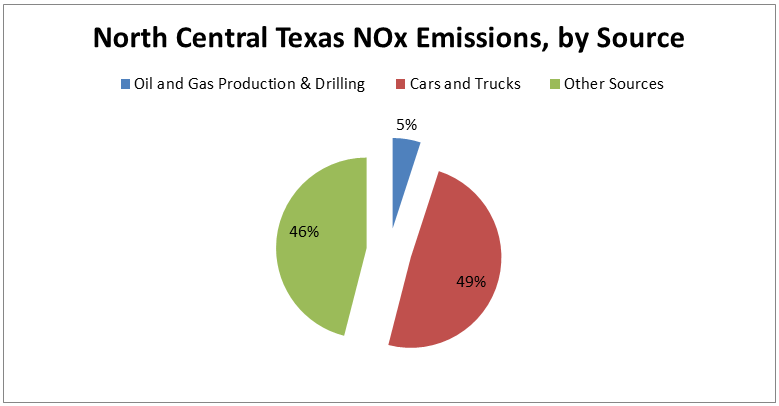
SOURCE: TCEQ and the North Central Texas Council of Governments, 2012
A few years later, TCEQ took another look at emissions
in the Barnett Shale region, and once again concluded that ozone
precursors from mobile sources exceeded those from oil and natural gas
production activities. According to TCEQ, “The estimated mobile source
NOx emissions are approximately 15 times higher than the oil and gas NOx
emission.” TCEQ further noted that VOC emissions from oil and gas were
“half of the mobile source VOC emissions.”

SOURCE: TCEQ
On TCEQ’s “Ozone History”
page for the Dallas-Fort Worth region, TCEQ notes that the “majority of
NOx emissions in the DFW area come from on-road mobile sources (cars
and trucks) and non-road mobile sources (such as construction equipment,
aircraft, and locomotives)” — not oil and natural gas production.
In
short, the paper’s conclusion that “the oil and gas sector likely has
greater emissions than motor vehicles” was not only incorrect, but also
rested on false assumptions about how ozone actually forms. That may
also explain how ozone in the Dallas-Fort Worth region could decline as Barnett Shale production grew.
South Texas Smog
Critics
have similarly linked ozone levels in San Antonio to the booming Eagle
Ford Shale, located about 50 miles south of the city. Like the
Metroplex, San Antonio has experienced rapid growth in recent years. In
just a two year span, from 2010 to 2012, more than 90,000 people moved to the south Texas metropolis, helping to make it the fourth-fastest growing major city nationwide. Experts say the rapid growth means the physical size of San Antonio could double by 2040.
Increased
population means additional cars and trucks on the road, along with
other economic development to support new jobs. These activities all
contribute to ozone formation, but environmentalists and other activist
groups have focused blame on emissions from the Eagle Ford, where daily oil production has grown by over 6,000 percent since just 2010, according to data from the Texas Railroad Commission.
For
example, Downwinders at Risk wrote last year that San Antonio’s public
officials “deny the link between the Eagle Ford and smog in their city.”
InsideClimate News has claimed that ozone
levels “began rising in 2007, with the steepest increase seen around
2011, just as the Eagle Ford boom exploded.” ICN also alleges that the
Eagle Ford is an “important factor”
in the region’s ozone (notably, the natural resources director for the
Alamo Area Council of Governments said ICN’s claim was based on
preliminary data that are “really not worth using”). In 2013, a report by Earthworks — which recently pledged a “war on fracking”
— alleged that oil and natural gas companies operating in the Eagle
Ford “are allowed to release hundreds of tons of air pollutants on an
annual basis,” including ozone precursors such as VOCs and NOx. A
representative from the Environmental Defense Fund told the Texas Tribune:
“We know that emissions from oil and gas drilling operations are
contributing to increases in ozone concentrations,” including in San
Antonio. But the most comprehensive data set on regional
emissions suggests that environmental groups are overstating the degree
to which Eagle Ford operations contribute to San Antonio’s ozone
problem.

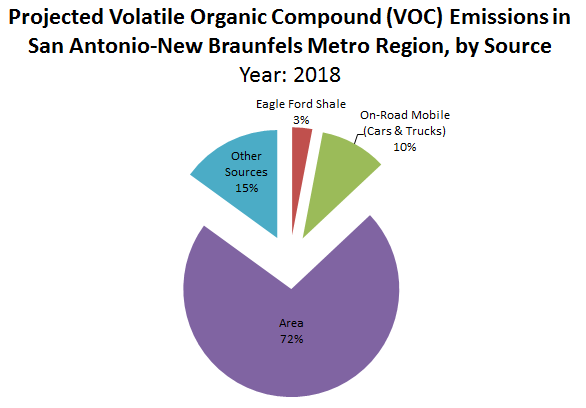
According to a report
from the Alamo Area Council of Governments (AACOG), VOC emissions from
cars and trucks in the San Antonio-New Braunfels metropolitan area were
more than ten times what emanated from Eagle Ford activities in 2012.
That same year, automobiles emitted approximately 20 times more NOx than
Eagle Ford operations. By 2018, emissions from automobiles are
projected to decline significantly, but VOCs and NOx from the Eagle Ford
will only account for about three percent of the region’s total
emissions.
As the San Antonio Express-News
reported in 2013, drilling-related emissions are largely in rural
counties, and “the total air pollution produced in Bexar County alone
could easily match” what’s emitted from the Eagle Ford, according to
AACOG.
Activists Tell EPA to Crackdown
Last week, the U.S. Environmental Protection Agency held two public hearings on its proposal
to reduce the National Ambient Air Quality Standard (NAAQS) for ozone
from 75 parts per billion (ppb) to between 65 and 70 ppb. Environmental
groups flooded the hearings with individuals calling for a stricter standard — 60 ppb — than what even the EPA claims would be cost-effective. An Energy In Depth analysis found
that EPA inflated the net benefits of its proposed ozone rule by as
much as 3,100 percent over what the Agency had determined for the same
standard just three years earlier.
Many of the environmentalists
testified that oil and natural gas production is a major contributor to
smog in Texas. Zac Trahan, program director at Texas Campaign for the
Environment, blamed “the fracking boom”
for ozone nonattainment in Dallas-Fort Worth. Luke Metzger with
Environment Texas told EPA that oil and natural gas production is a “major source of air pollution in Texas,” adding that drilling activity in the Eagle Ford is “putting San Antonio at risk of nonattainment.”
Based
upon the data, however, the environmentalists’ claim that “fracking” is
pushing major Texas cities into nonattainment is without merit.
http://theenergycollective.com/saeverley/2190001/data-show-texas-ozone-levels-are-not-driven-fracking
No comments:
Post a Comment