
Framing of decarbonisation pathways needs to take the value in
use of low carbon technologies into account. This can provide a fuller
and more positive guide to policy than analysis of marginal abatement
costs alone.
Much analysis of pathways for decarbonising
economies takes as its starting point Marginal Abatement Costs (MACs),
looking at the cost per tonne of reducing emissions. This is a useful
perspective, for example highlighting the cost effectiveness of improved
insulation in buildings. However, framing decarbonisation as a problem of costs incurred in reducing emissions
risks ignoring other characteristics of a low carbon economy. A
broader and more positive framing needs to consider how a more attractive low carbon future can
be realised. This broader framing emphasises some of the potential
benefits of low carbon technologies, as well as focussing on non-price
barriers to adoption. Such a framing can offer a more useful guide to
the range of policies needed to develop low carbon pathways. (I should
also note that carrying out reliable MAC analysis can itself pose
significant challenges. Some of these are reviewed at the end of this
post, but here the main focus here is on those issues difficult to
accommodate within the MAC framework).
MAC analysis tends to
assume that the reduction in emissions is the main difference between
two products which are otherwise very similar (very close substitutes
for each other). This is largely valid for commodities such as
electricity, although even here issues such as timing and reliability of
generation need to be considered. However for most consumer goods improving characteristics in use can
greatly increase their value. Making low carbon products cheaper is
crucial. But if they are also better than the higher carbon
alternatives this will lead to much more willing and rapid adoption.
Electric vehicles
illustrate how non-price attributes can provide additional value to
consumers and others, but can also create barriers to adoption.
Electric vehicles have a number of characteristics, which, at least in
my experience, make them preferable to their internal combustion engine equivalents.
They are quiet and pleasant to drive, as the Nissan Leaf, the world’s
best-selling electric car to date, and the more recent BMW i3 both
demonstrate. Refuelling by simply plugging in overnight is convenient,
and there is no need to visit petrol stations, which are not generally
pleasant places to be despite the best efforts of oil companies to make
them more appealing. Low centres of gravity lead to good road holding,
and electric motors are instantly responsive, making for smooth and
often rapid acceleration. Performance has been one of the main selling
points of the Tesla S, and responsiveness is one reason electric motors
are finding their way into hybrid drive trains even on high performance
cars such as my local car factory’s premiere product, the astonishingly
quick and vastly expensive McLaren P1.
While car markets are
highly competitive the variation in price for similar cars shows that
consumers are often prepared to pay a premium for a car with improved
characteristics. For example, variants of the Volkswagen Golf hatchback
range in price from £17,000 to £26,000. Electric vehicles may
similarly be able to realise premiums that reflect their benefits, with
the Tesla S already the bestselling car in a third of the richest US
postal codes.
Wider benefits may also play a role in adoption of low carbon technologies. Local air quality is
improved by the absence of emissions of particulates and other local
pollutants. This has led some cities to encourage electric vehicles,
with, for example, plans for all new London taxis to be zero emission by
2018. Such non-GHG benefits are produced jointly with greenhouse gas
emissions reduction and will in some cases dominate the case for change.
There are also non-price barriers
to the use of EVs that can also affect uptake, most notably
availability of recharging points to enable longer journeys. To ease
these difficulties governments and the industry are expanding charging
networks. However range limitations remain, along with
price, the biggest obstacle to uptake for most electric vehicles. The
Tesla S largely overcomes the range problem with its 300 mile range,
but at over £60,000 excluding the government incentive it is not a cheap
vehicle. Plug-in hybrids largely avoid the range problem by retaining
an internal combustion engine or on-board generator, but with some
compromises of their own.
Similarly, there is much that manufacturers can do to make other low carbon products more appealing. The chart below shows the spectrum from different types of lighting.
The quality of the light is very different in each case, with the light
from compact fluorescents (CFLs) clearly much less continuous than from
other sources. Whatever else, these are clearly not exact
substitutes. It was perhaps premature for the EU to regulate
incandescent electric light bulbs out of the market when many people
found the light from the substitutes less appealing, and while better
than CFLs there may be much manufacturers can still do to improve the quality of light from LEDs, alongside continuing reductions in costs.

To take one more example of non-price characteristics from among many, there is surely room for improvement in the aesthetics of rooftop solar panels, at least in some contexts, and a number of innovators are working on this.
Fortunately,
gauging and meeting consumer preferences is something markets do rather
well, at least when consumers know what they want and can tell what has
been delivered. So markets have an important role to play in
decarbonisation. But it will be the behaviour of markets for low carbon
products as well as markets carbon such as the EUETS that will be
crucial to successful decarbonisation.
Decarbonising an economy is
difficult and complex. It can be made easier if new technologies not
only have lower carbon dioxide emission than the alternatives, but are
also better in other respects. Policy can help promote this by
stimulating innovation, enabling early adoption and removing barriers.
If the future not only has a safer, more stable climate, but is also brighter, cleaner, better looking, and more fun to drive around it will be a lot easier to persuade people that it’s a future in which they wish to invest.
Adam Whitmore – 28th February 2014
Challenges in applying a marginal abatement cost framework – Electric vehicles as an example
MAC
analysis is further limited by difficulties of application in
practice. Several factors complicate estimates of the cost of
abatement, and some of these are illustrated here by reference to
electric vehicles. These factors can be, and sometimes are, taken into
account in careful analysis of abatement costs. However they are
difficult to treat properly, because of the scope of the modelling
frameworks and the amount of information they require make them very
demanding to assess.
First, the quantity of emissions avoided, and thus cost of abatement, is very dependent on the emissions intensity of the source of electricity.
For example, Norway, currently the world leader in the deployment of
EVs, has a mainly hydro based grid, leading to relatively large
emissions reductions. However emissions from electricity generation
will be greater in countries with fossil based systems, which will lead
to a lower reduction in emissions and higher abatement costs, other
things being equal. However just how much lower may depend on factors
such as when EVs are charged, and what the marginal generating plant on
the system is at that time.
Furthermore, lifecycle emissions of the vehicle itself
can vary greatly between EV models and even between the same model made
with materials from different sources. For example, the emissions from
smelting aluminium for a lightweight body can be very different
depending the source of the electricity used in smelting, and emissions
will be different again in making a carbon fibre body such as that used
for the BMW i3 and i8. An additional complication is that many
lifecycle emissions can fall outside the jurisdiction being assessed,
and may be covered by a quite different set of policies.
Costs can also change greatly over time,
sometimes to an unanticipated extent. Batteries account for a large
proportion of the cost of an EV, but costs are falling rapidly. The
chart below shows that in the last five years costs have more than
halved and energy densities, which set the size of battery pack, have
more than doubled.
This trend seems likely to continue as a result of continuing R&D and increasing deployment. Such technology spill-over
benefits from early deployment are difficult to account for in a MAC
analysis. They are among the reasons EVs currently attract financial
incentives in many jurisdictions, for example a £5000 grant in the UK,
$7500 Federal Tax Credit in the USA, and exemption from VAT and purchase
tax in Norway. Other incentives can also play a role in stimulating
early adoption, including exempting EVs from tolls or congestion
charges, allowing EVs on High Occupancy or bus lanes, providing free
parking, and mandating tight emission standards.
Modelled cost and energy density of PHEV batteries developed and tested
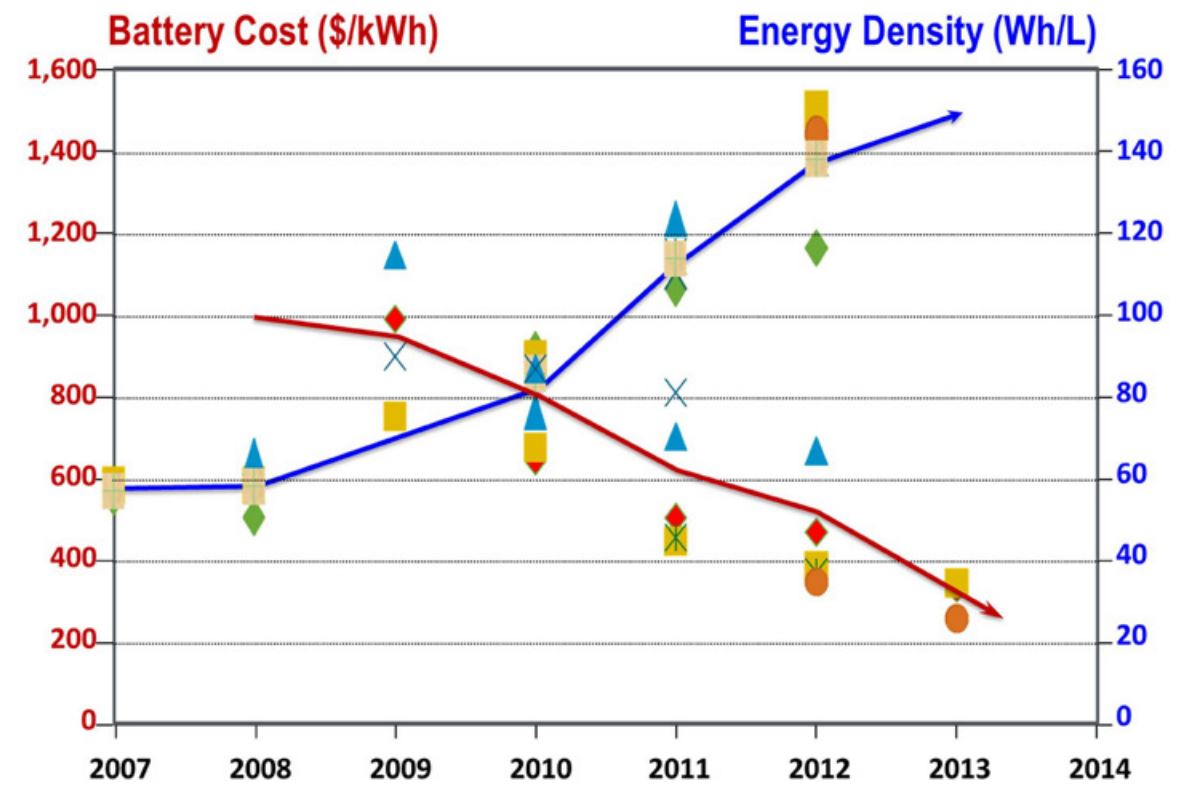
Source: US DoE report
published as part of their EV programme. For a comparison changing the
specification of a Tesla S from a 60kWh battery to an 85kWh battery
(the two models are otherwise quite similar) increases the price by
£6170 excluding VAT, which is $400/kWh (see here).
Data in the main body of the post on the sales of the Tesla S in prosperous postcodes is from
No comments:
Post a Comment