
One of the odd circumstances that arises out of extracting,
transporting and marketing a commodity in high demand is that overall
industry profits can increase as an indirect result of experiencing a scary accident that destroys a portion of a now infamous small town
and kills nearly four dozen people.
One predictable response to such an
accident is for regulatory bodies to impose rules that slow production;
when that happens the market often reacts with unit price increases
that benefit oil producers.
Here is the sequence. In June 2013,
crude oil production in North Dakota was continuing to soar, partially
assisted by an increasing number of rail terminals that ease constraints
on market access for drilling companies. The increased terminal
capacity increased the rate at which cars could be loaded and sent on
their way to lucrative market destinations.
In 2013, there were
400,000 tank car loads of crude oil shipped in the United States, up
from just 10,000 cars in 2009. Each tank car carries a little more than
700 barrels of oil; the average rate of transportation via rail was
almost 800,000 barrels of oil per day.
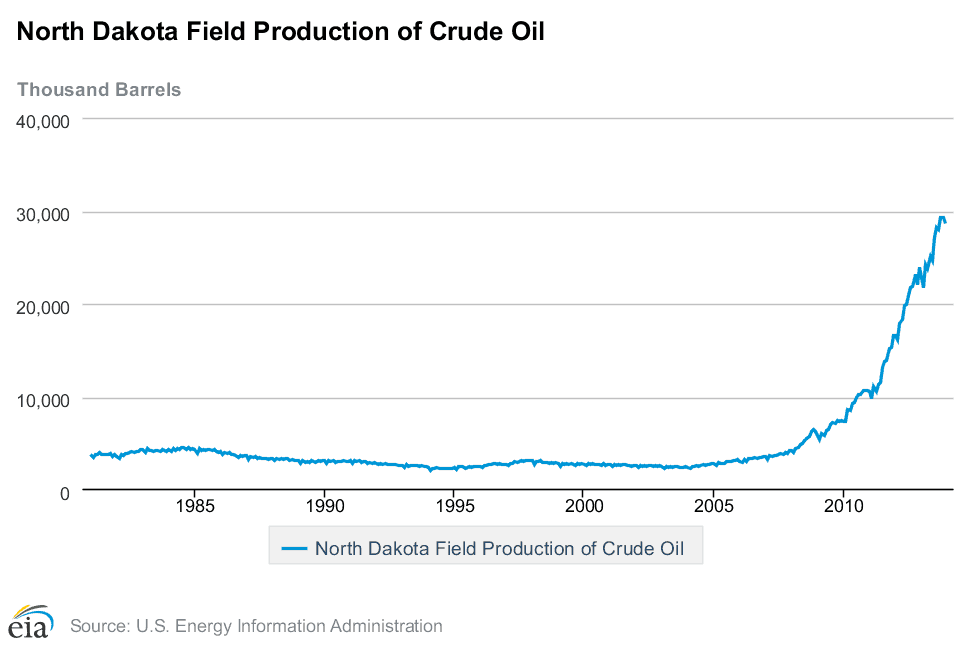
North Dakota oil production history
Partially
due to the increasing production rate from North Dakota’s Bakken
formation, crude oil prices in the summer of 2013 continue trading for
well under $100 per barrel; the Energy Information Agency reports a June
2013 price for West Texas Intermediate (WTI) of $95 per barrel.
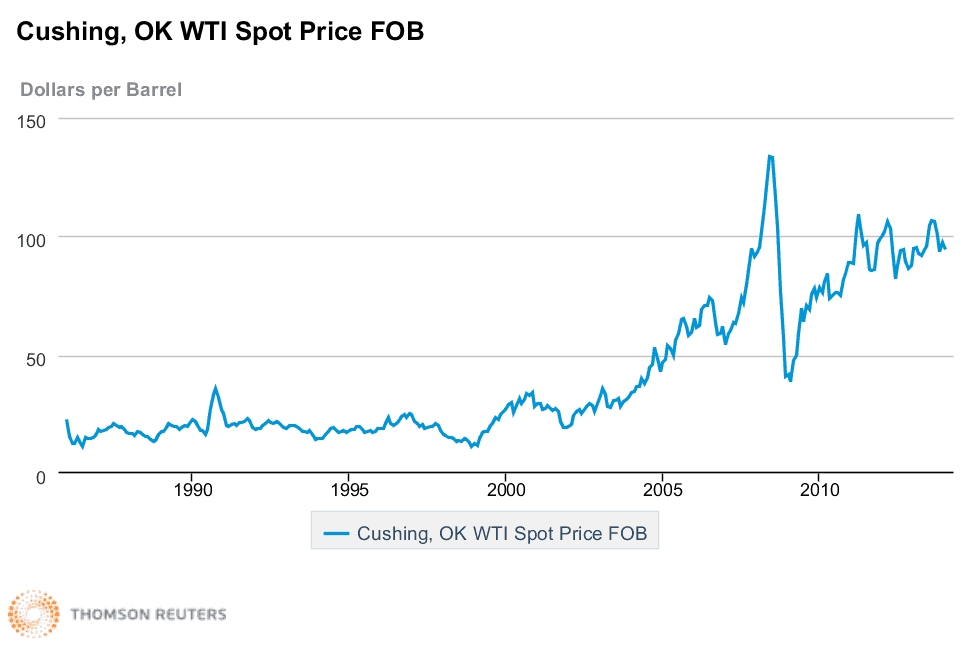
Oil price history – Cushing, OK WTI spot
In early July 2013, a train carrying crude oil extracted from the Bakken formation in North Dakota suffered a major accident
that resulted in an explosion and subsequent conflagration that
destroyed significant portions of Lac-Megantic Ontario and killed 47
people. The rail cars carrying the crude oil were the same DOT-111s used to transport the majority of crude oil in the US; approximately 69% of the liquid tanker cars in the US are DOT-111s.
Accident
investigators blamed the lower flash point of Bakken light sweet crude
oil for increasing the consequences of the rail car derailment. They
later discovered that the cargo had been incorrectly categorized as packing group 3,
which is the least hazardous category of flammable materials. It should
have been classified as packing group 2, which is the same category as
gasoline.
At the time of the fiery accident, properly categorizing
the material would not have changed the tank car requirements but it
would have more correctly informed first responders about the hazards
they would be facing in fighting the blaze. Since July 2013, there have
been additional accidents involving rail cars carrying crude oil. The
ones involving crude from the Bakken, including a November 8 derailment in rural Alabama and a December 30 derailment near Casselton, ND
have resulted in explosions and conflagrations but no injuries to
people because they happened on open sections of the track where there
were no people nearby.
On February 25,
the Federal Railroad Administration, which is an agency of the
Department of Transportation, issued emergency rules that require
shippers to more frequently test and certify the contents inside tanker
cars before shipment. On Friday, February 28, Reuters reported that the
WTI price for the week closed at $102.59, completing a string of eight
weeks of increasing prices. The reporter credited
discussions of slowing shipments from the Bakken formation as the
reason that traders believed that supplies would fall in relation to
demand. There were some rumors that some Bakken rail terminals were
closed; the more likely case is that the additional testing requirements
slowed the loading processes.
Oil production in the US is
approximately 8.5 million barrels of oil per day; each dollar increase
in the price increases the revenue in the extraction end of the business
by about $3 billion per year.
Yesterday, Warren Buffett, a well
diversified investor whose Berkshire Hathaway holding company owns both
BNSF, which is a major shipper from the Bakken formation, and a company
that produces tanker rail cars, told an interviewer on CNBC that he expected new rules to require additional safety improvements to the tanker car fleet.
In
some ways, this series of events brings back memories of the aftermath
of the Deepwater Horizon accident that resulted in 11 deaths and a six
month period of dumping millions of gallons of crude oil into the Gulf
of Mexico. Most parts of the petroleum business, including the owners of
the polluting well, benefitted as crude oil prices gradually increased
around the world as a result of moderate extraction restrictions. Though
there were other pressures, the slowing of exploration and production
from the Gulf of Mexico contributed to a rise from a summer 2010 crude
oil price of about $75 per barrel to a spring 2011 price of $123 per
barrel.
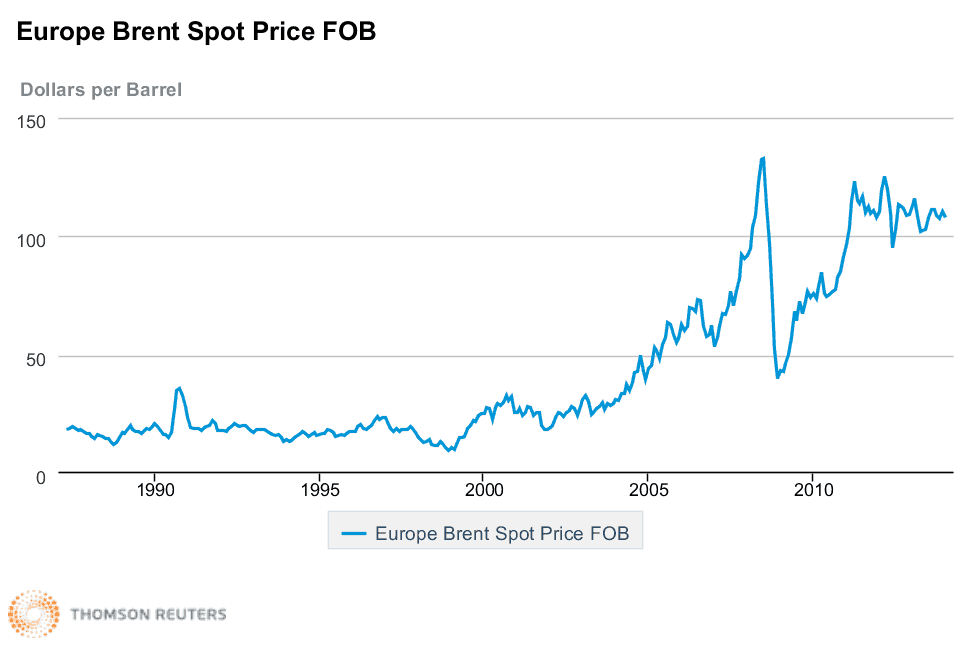
Europe Brent spot price through 2013
In
contrast, the consequences of the disaster at Fukushima, where an epic
tsunami wiped out the power supplies for a nuclear power station and
created a situation that destroyed four reactors — three of which were
loaded with fuel and operating at the time the wave hit — has created a
widespread slowdown in the nuclear industry. Market effects of that
event include contributing to a dearth of new plant orders in most parts
of the world, a loss of nuclear plant output, and a reduction in
nuclear fuel consumption that has pushed the price of uranium down to
levels last seen in the 1990s.
http://theenergycollective.com/rodadams/349656/new-testing-rules-benefit-oil-producers
No comments:
Post a Comment