
In my view, oil and gas resource limits are major contributors to the conflict in Syria. This is happening in several ways:
1. Syria is an oil exporter that is in increasingly perilous financial condition because of depleting oil resources. When
oil production is increasing, it can help an oil exporter in two ways:
(a) part of the of the oil supply can be used internally, to grow more
food and to support increased industry, and (b) exports of oil can be
used to provide revenue for governmental programs such as food
subsidies, education, and building highways. Syria’s population grew
from 8.8 million in 1980 to 22.8 million in 2012, at least in part
because of the wealth available from oil extraction.
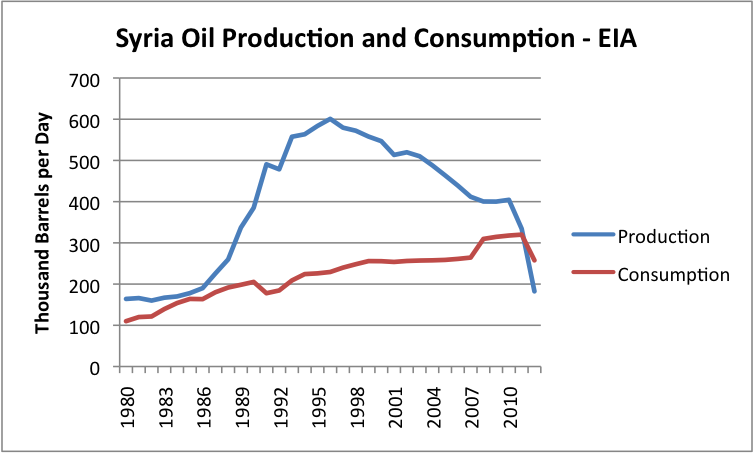
Figure 1. Syria’s oil production and consumption, based on data of the US Energy Information Administration.
Now
Syria’s oil production is dropping. The drop between 1996 and 2010
reflects primarily the effect of depletion. The especially steep drop in
the last two years reflects the disruption of civil war and
international sanctions, in addition to the effect of depletion.
When
oil exports drop, the government finds itself suddenly less able to pay
for programs that people have been expecting, such as food subsidies
and new irrigation programs to support agriculture. If revenue from oil
exports is sufficient, desalination of sea water is even a possibility. In Syria, wheat prices doubled between 2010 and 2011,
for a combination of reasons, including drought and a cutback in
subsidies. When basic commodities become too high priced, citizens tend
to become very unhappy with the status quo. Civil war is not unlikely.
Thus, oil depletion is likely a significant contributor to the current
unrest.
Egypt has many Similarities to Syria
Egypt
is another example of an oil exporter whose oil production has dropped
because of geological decline. Its chart of oil production and
consumption (Figure 2) looks very much like Syria’s (Figure 1).
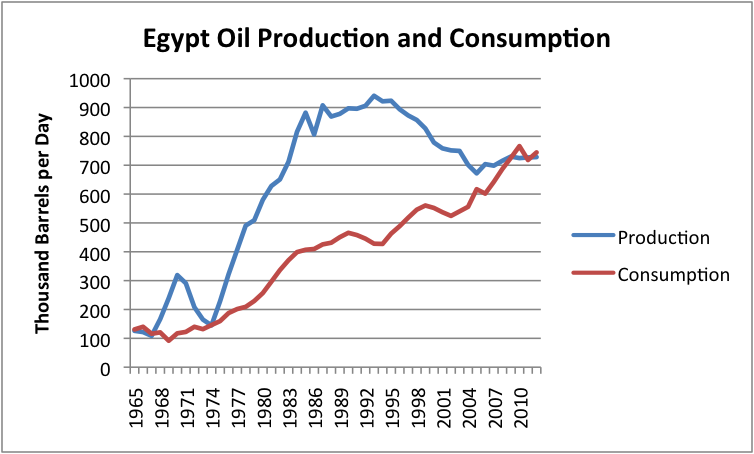
Figure 2. Egypt’s oil production and consumption, based on BP’s 2013 Statistical Review of World Energy data.
Egypt
is actually doing a little better than Syria. One of the things that
has helped Egypt is its natural gas production, because it has been
another source of export revenue. Unfortunately, Egypt’s natural gas
production suddenly flattened starting in 2009, again because of
depletion (Figure 3).
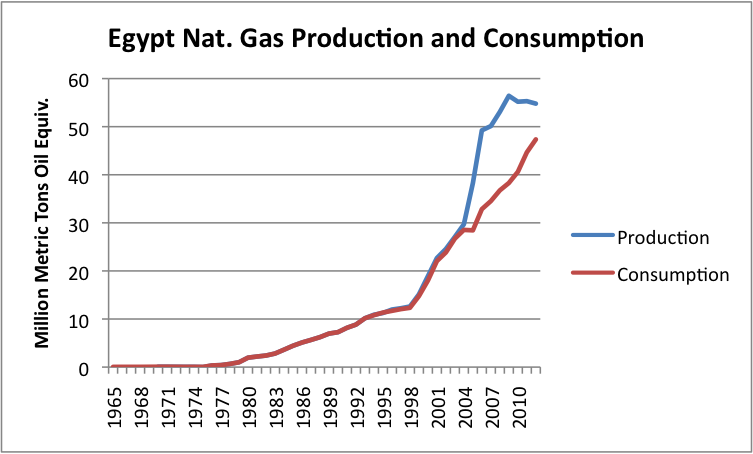
Figure 3. Egypt natural gas production and consumption based on BP 2013 Statistical Review of World Energy.
As
Egypt started losing oil supplies, it was able to keep its own energy
consumption growing (to keep up with growing population) by rapidly
cutting back on exported natural gas (even though it had contracts in
place to sell some of the this natural gas). Part of this cutback was to its pipeline customers,
namely Israel, Lebanon, and Syria. Of course, this left Egypt with less
foreign revenue to fund subsidies, education, and many other programs,
but Egypt’s own energy consumption (Figure 4) was able to keep growing,
helping agriculture and industry to function as normal.
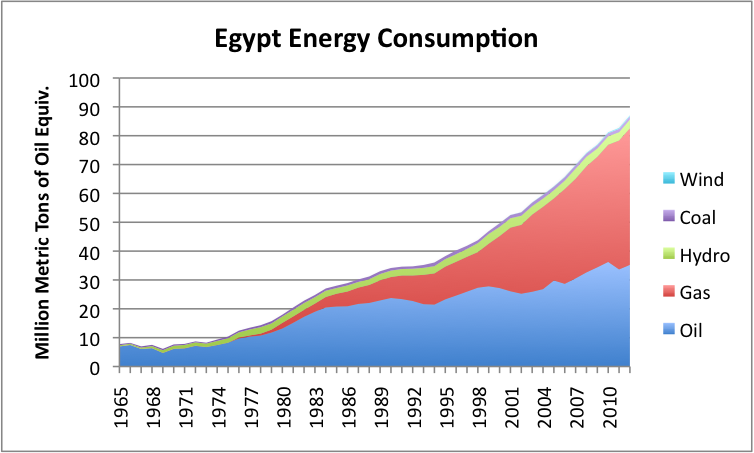
Figure 4. Egypt’s energy consumption by source, based on BP 2013 Statistical Review of World Energy.
Syria,
on the other hand, was consuming all of the natural gas it produced. In
fact, is was importing a little gas from Egypt, so it had no exports it
could cut back on. In fact, Egypt’s cutback worked the wrong way from
Syria’s perspective–it lost a small amount of natural gas imports from
Egypt.
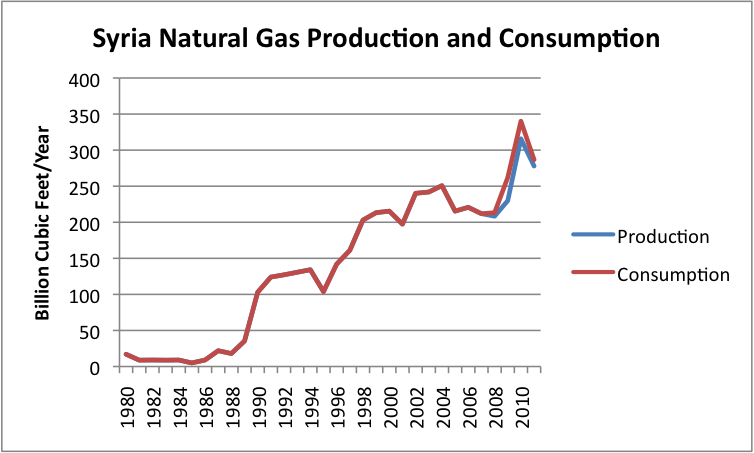
Figure 5. Syria Natural Gas production and consumption, based on data of the US Energy Information Administration.
As a result, Syria found its energy consumption decreasing (Figure 6), even as population continued to rise.
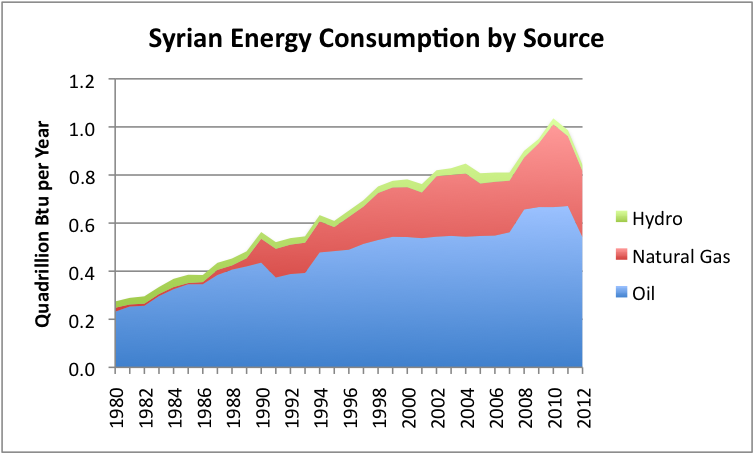
Figure 6. Syria Energy Consumption by Source, based on EIA data.
At least part of the decline in Syria’s energy consumption occurred because of damage to oil and gas pipelines and to electrical transmission equipment. According to the CIA Fact Book,
Syria’s industrial production shrank by 36% in 2012. Thus, geological
depletion and the civil war that grew out of inadequate resources both
contributed to the drop in energy consumption.
Going forward, this
tendency toward civil disorder is likely to get worse, whether or not
the US decides to attack. The underlying issue in Figure 1 is depletion.
Population remains high. Even if damage to pipelines and transmission
lines get fixed, the depletion issue will continue, and the population
will need to be fed.
2. Economic sanctions, to the extent
they have an affect, can be expected to act similarly to resource
depletion and increase the tendency toward civil disorder.
Syria has been operating under economic sanctions from the US since 2004.
To the extent that these had an effect, one would expect that they
would reduce economic activity, and thus energy consumption. It is hard
to see a significant change in energy use patterns in the years
immediately after 2004, from the charts provided.
Many other countries have added sanctions since hostilities broke out in 2011. It
is difficult to tell how much effect the 2011 sanctions have actually
had. It is possible that they contributed to Syria’s drop in energy
consumption. It is also possible the civil disorder together with
depletion explain the recent drop in oil production and consumption.
Even with sanctions, Syria continues to participate in international trade. According to the EIA, Syria continues to trade with Russia, Iran, Iraq, Malaysia, and Venezuela. Other sources mention China (here and here) as a trading partner with Syria. North Korea is also mentioned as being a trading partner, especially in the area of chemical weapons.
3. Oil pipelines from Iraq through Syria would be helpful if Iraq is to greatly ramp up its oil output in the next few years.
The
United States has an interest in getting oil production from Iraq
ramped up, in the hope that world oil production can continue to rise.
World oil production has been increasingly flat, even taking into
account liquid substitutes and new sources, such as biofuel and new US
tight oil production.
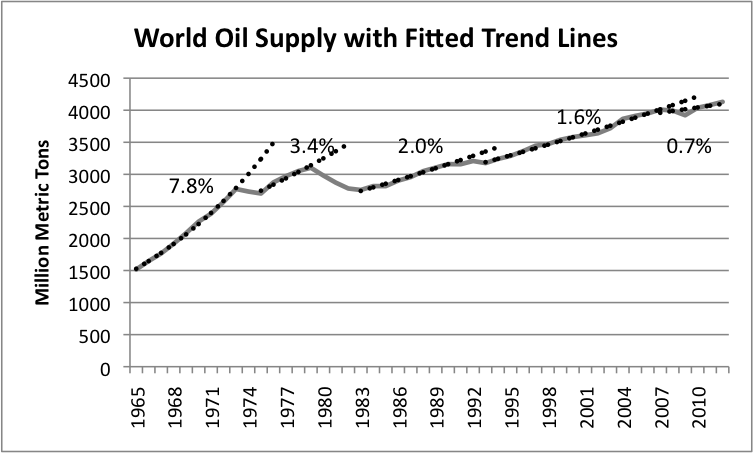
7. Growth in world oil supply, with fitted trend lines, based on BP 2013 Statistical Review of World Energy.
One
of the limits in ramping up Iraqi oil extraction is the limited amount
of infrastructure available for exporting oil from Iraq. If pipelines
through Syria could be added, this might alleviate part of the problem
in getting oil to international markets. According to the EIA,
One particular project proposes to build two oil pipelines (and one for natural gas) that would send Iraqi crude to the Mediterranean coast in Syria, and from there to international markets. The first of the proposed pipelines would send heavier crudes from northern Iraq and have a capacity of 1.5 million bbl/d. The second pipeline would send lighter grades from southern Iraqi fields, and would follow the same route as the former Haditha-Banias pipeline; the second section is scheduled to have a 1.25 million bbl/d capacity.
4. The
possibility of natural gas pipelines through Syria to alleviate
potential shortages in Europe and elsewhere is contentious.
Russia
currently is a major exporter of natural gas to Europe. It would like
to keep natural gas prices as high as possible because of the high cost
of its natural gas extraction, and because of the high cost of building
new pipelines. Russia does not necessarily welcome new natural gas
production from, for example, Qatar or Israel, carried by pipeline
through Syria. Such new supply might reduce natural gas prices in
Europe, either because of oversupply or because the other natural gas
sources have a lower cost of extraction and transport.
If new
pipelines are built through Syria, there are several countries that
might theoretically ship natural gas through such pipelines, and there
is considerable rivalry among these countries. For example, Israel and
Iran are rivals as to which country might export natural gas to Europe.
Also, as noted above, there is a possibility that natural gas from Iraq
could be exported through Syria to the international market, if suitable
pipelines were built. There is even theoretically a possibility that
natural gas from Turkmenistan could be exported by pipeline through
Iran, Iraq and Syria, cutting out Russia (and the profits it receives in
buying, transporting and selling this gas).
It should be noted
that even though many countries have their sights set on exporting
natural gas to Europe and other parts of the world that need natural
gas, it is not at all clear that this additional transport of natural
gas will work out as planned. We have known for a long time about a
large amount of “stranded” natural gas–gas that is theoretically
available, but it simply too expensive to extract and ship to locations
where it might be purchased. The limits on how much natural gas will be
consumed are financial–how much can consumers really afford.
The
affordability issue is clear if we think about a family in India, living
on $2 a day, deciding whether to burn animal dung or compressed natural
gas for cooking. If the price of natural gas is high, the family in
India will choose to burn dung. A similar issue arises for a pensioner
in the UK, deciding to what temperature to heat his home. It also arises
for an electric power plant in Germany, deciding whether to burn natural gas or coal.
If the cost of natural gas is too high, demand is likely to shift to
cheaper fuels, or to disappear through alternative behavior–for example,
wearing long underwear to keep warm in winter, instead of heating homes
as warmly as today.
5. Need for America to prove its might, to maintain the US dollar’s reserve currency status.
Without
the reserve currency status of the US dollar, America cannot continue
to run a big balance of payment deficit importing large quantities of
oil. This is important, because the world’s total oil supply is not
growing much (Figure 7), regardless of price. If America is forced to
consume less, more oil will be available for the rest of the world.
Conclusion
Because
of its oil depletion, Syria will remain a problem country, regardless
of whether the US decides to intervene militarily. Removing Assad as
leader of Syria cannot be expected to solve Syria’s problems. Even if
oil deletion were not the major issue, US’s recent experience in Libya
suggests that removing a leader does not guarantee future stability.
Associated Press reports this week, Libya’s oil exports plunge as problems escalate.
Some
may argue that Syria has other gas and oil that it can exploit, and
because of this, its depletion problems are only temporary. In
particular, the EIA report on Syria
notes that there are both shale oil resources in Syria and natural gas
resources offshore that Syria might develop. In my view, there are
several reasons that this optimism is unwarranted. As a practical
matter, even if there were peace and plenty of investment capital,
developing these resources would take several years. During this period,
other countries would need to donate enough resources to keep the
population pacified. Can this really be done, especially if other
countries are reaching limits themselves?
Furthermore, it is not
at all clear that extraction of oil from shale can really be developed
profitably. No one outside North America has yet figured out how to do
so. The US has laws and pipeline infrastructure that are different from
elsewhere that help make shale development possible at reasonable cost.
Available credit and low interest rates are also helpful. The US also
has abundant water resources, and population that is not too dense, so
that fracking is less of an issue than it would be elsewhere. A recent Wall Street Journal article talks about the difficulty China is having trying to extract hydrocarbons from shale.
There
is also the question I mentioned above with respect to the economic
feasibility of new natural gas resources. If the cost is too high, the
cost may simply be too high for buyers. Furthermore, if buyers find a
need to cut back on other expenditures to purchase gas products (or for
that matter, high-priced oil products), they are likely to cut back in
the purchase of other discretionary items. Layoffs are likely to occur
in discretionary sectors, leading to recession and reduced demand
through fewer jobs. Thus, one way or another, a reduction in demand is
likely to occur.
Egypt and Syria are not the only countries in the
area with oil depletion problems. Yemen’s oil chart of oil production
and exports (Figure 8) looks very much like that of Syria and Egypt.

Figure 8. Yemen oil production and consumption, based on US Energy Information Administration data.
Saudi Arabia may even be reaching limits on its extraction capability. It recently is reporting refocusing on unconventional resources,
something it would not do if conventional oil were performing well.
Saudi Arabia is also using a greater number of drilling rigs, reported
to be necessary because of the increasing difficulty of extracting oil from mature fields.
If
oil depletion is becoming an increasing problem, I am afraid we can
expect increasing conflict in the Middle East, regardless of whether the
US chooses to intervene in Syria because of increased oil depletion. A
shortfall in one country can ripple to the next country, and on to the
next country, as exports are reduced, and as civil unrest spreads.
It
is easy to blame bad leaders for the problem, or a bad form of
government. Much of the problem, however, is simply not having enough
oil resources to go around for the size of population the world has
today. We can kid ourselves about additional oil and natural gas
resources being available, but these very much depend on the ability of
buyers to pay higher prices, without excessive recessionary impacts.
http://theenergycollective.com/gail-tverberg/271176/oil-and-gas-limits-underly-syria-s-conflict
No comments:
Post a Comment