

Source: U.S. Energy Information Administration, Electric Power Monthly, December 2013 edition
Note: Data include facilities with a net summer capacity of 1 MW and above only. Note: See details by technology type.
Note: Data include facilities with a net summer capacity of 1 MW and above only. Note: See details by technology type.
Natural
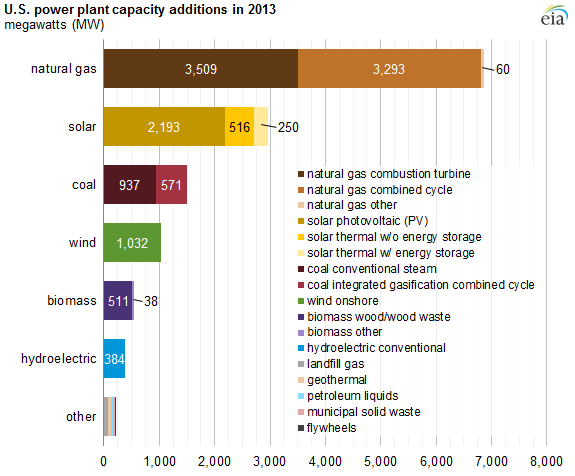
gas-fired power plants accounted for just over 50% of new utility-scale
generating capacity added in 2013. Solar provided nearly 22%, a jump up
from less than 6% in 2012. Coal provided 11% and wind nearly 8%. Almost
half of all capacity added in 2013 was located in California. In total,
a little over 13,500 megawatts (MW) of new capacity was added in 2013,
less than half the capacity added in 2012.
Natural gas. Natural
gas capacity additions were less than in 2012, as 6,861 MW were added
in 2013, compared to 9,210 MW in 2012. The capacity additions came
nearly equally from combustion turbine peaker plants, which generally
run only during the highest peak-demand hours of the year, and
combined-cycle plants, which provide intermediate and baseload power.
Nearly
60% of the natural gas capacity added in 2013 was located in
California. The state is facing resource adequacy concerns as well as
the need for more flexible generation resources to help complement more
variable-output renewable resources, particularly solar, being added to
the system.
Solar. Solar photovoltaic (PV) added
2,193 MW of capacity in 2013, continuing the trend of the past few years
of strong growth, helped in part by falling technology costs as well as
aggressive state renewable portfolio standards (RPS) and continued federal investment tax credits.
Nearly 75% of the capacity added was located in California, followed by
roughly 10% in Arizona. (Note: these figures do not include distributed
capacity under 1 MW. Distributed solar PV capacity additions also grew
in 2013, with industry reports estimating nonutility additions of 1,900 MW. Most of this capacity was also located in California.)
After many years of little activity, the solar thermal industry completed several large-scale solar thermal plants
in 2013 located in Arizona and California totaling 766 MW of capacity,
more than doubling the total solar thermal capacity in the United
States. A few more projects are expected to be completed in 2014-16;
however, several other announced projectes have since been cancelled or
suspended because of a number of challenges such as environmental
impacts on desert wildlife and water resources, cost-competitiveness,
and delays in transmission development.
Coal. Two
coal plants, both delayed projects that were originally scheduled to be
completed in 2011-12, accounted for all of the coal capacity added in
2013. The Sandy Creek Energy Station
in Texas is a 937 MW conventional steam coal plant that was badly
damaged during testing in 2011 and required major repairs before
becoming operational. The Edwardsport
plant in Indiana is a 571 MW integrated gasification combined-cycle
(IGCC) plant, one of only two of the many proposed IGCC projects that
actually advanced into construction as natural gas prices dropped (the
Kemper County IGCC project in Mississippi is still under construction).
Wind. Wind capacity additions (1,032 MW) dropped sharply in 2013 to less than one-tenth of the capacity added in 2012 (12,885 MW). This was a widely expected result of the rush to complete wind projects in 2012 to qualify for the federal production tax credit.
Unlike previous versions of the tax credit, the one-year extension for
2013 allowed developers to claim the tax credit for projects that began
construction in 2013 even if the project will be completed in a later
year. Consequently, developers were not as pressured to complete wind
projects by the end of 2013. At this time, there have not been any
subsequent extensions of the tax credit. More than 90% of the wind
generation capacity additions in 2013 were located in five states:
California, Kansas, Michigan, Texas, and New York (see graph at end of
article).

Source: U.S. Energy Information Administration, Electric Power Monthly, December 2013 edition
Note: Data include facilities with a net summer capacity of 1 MW and above only. California. California added 6,395 MW of capacity, 47% of all capacity added in 2013. The state has added a large amount of new capacity in an effort to deal with a number of problems challenging the state's resource adequacy and grid reliability, including:
Note: Data include facilities with a net summer capacity of 1 MW and above only. California. California added 6,395 MW of capacity, 47% of all capacity added in 2013. The state has added a large amount of new capacity in an effort to deal with a number of problems challenging the state's resource adequacy and grid reliability, including:
- California’s once-through cooling water policy, passed in 2010, is requiring power plants using once-through cooling—a substantial portion of the state's existing capacity—to either invest in costly retrofits to reduce their water consumption or retire over the next decade.
- The unexpected outage in 2012, and subsequent permanent retirement in 2013, of the 2,150 MW San Onofre Nuclear Generating Station (SONGS) plant in Southern California further exacerbated the state's near- to mid-term resource adequacy and reliability concerns.
- California's Renewable Portfolio Standard policy requiring 33% renewable energy by 2020 has led the state's electric utilities to procure new renewable capacity at a far higher rate than any other state. Integrating these growing levels of variable renewable generation has required more flexible resources to maintain grid reliability and to adapt to the grid's evolving generation needs.

Source: U.S. Energy Information Administration, Electric Power Monthly, December 2013 edition
Note: Data include facilities with a net summer capacity of 1 MW and above only.
Note: Data include facilities with a net summer capacity of 1 MW and above only.
Principal contributor: April Lee
http://theenergycollective.com/todayinenergy/365371/half-power-plant-capacity-additions-2013-came-natural-gas
No comments:
Post a Comment